
Summary of Content
- The AI Gap: Tactical vs. Strategic
Learn why 75% of organizations fail to see a return on investment from AI and how scattered, ad-hoc usage holds teams back. - The 7-Step AI Strategy Roadmap
Discover the exact step-by-step framework we use to align AI initiatives with core business priorities. - Prioritizing Use Cases with Find-Fit-Fly
Understand how to evaluate, test, and scale your AI efforts for maximum operational and financial impact. - The Measurement Hierarchy for AI
Learn how to track leading, operational, and financial indicators to prove real ROI to your leadership team.
The AI Gap: Tactical vs. Strategic
I have been involved in digital marketing and training businesses on AI for years as the CEO of Boot Camp Digital. Right now, almost everyone is using AI, but we are seeing a massive disconnect between everyday users and executive leadership. Executives want to know how AI drives the organization forward, while individuals are often just focused on saving 10 minutes on a daily task.
Currently, 75% of organizations report their teams use AI, but they are not seeing a return on investment. This happens because AI usage remains tactical rather than strategic. Tactical usage solves a specific problem for one person, while strategic usage fundamentally changes how the organization operates. We often see that under 5% of professionals are truly fluent with AI, even if they overestimate their skills because they use it for basic content creation.
When we use AI strategically, we drive ROI by saving time, increasing execution speed, saving money, and improving work quality. For example, by integrating AI into our content finalization process, we instantly generate clickable indexes for our blog posts. This improved the quality of our work in a way we never had the time to execute manually.
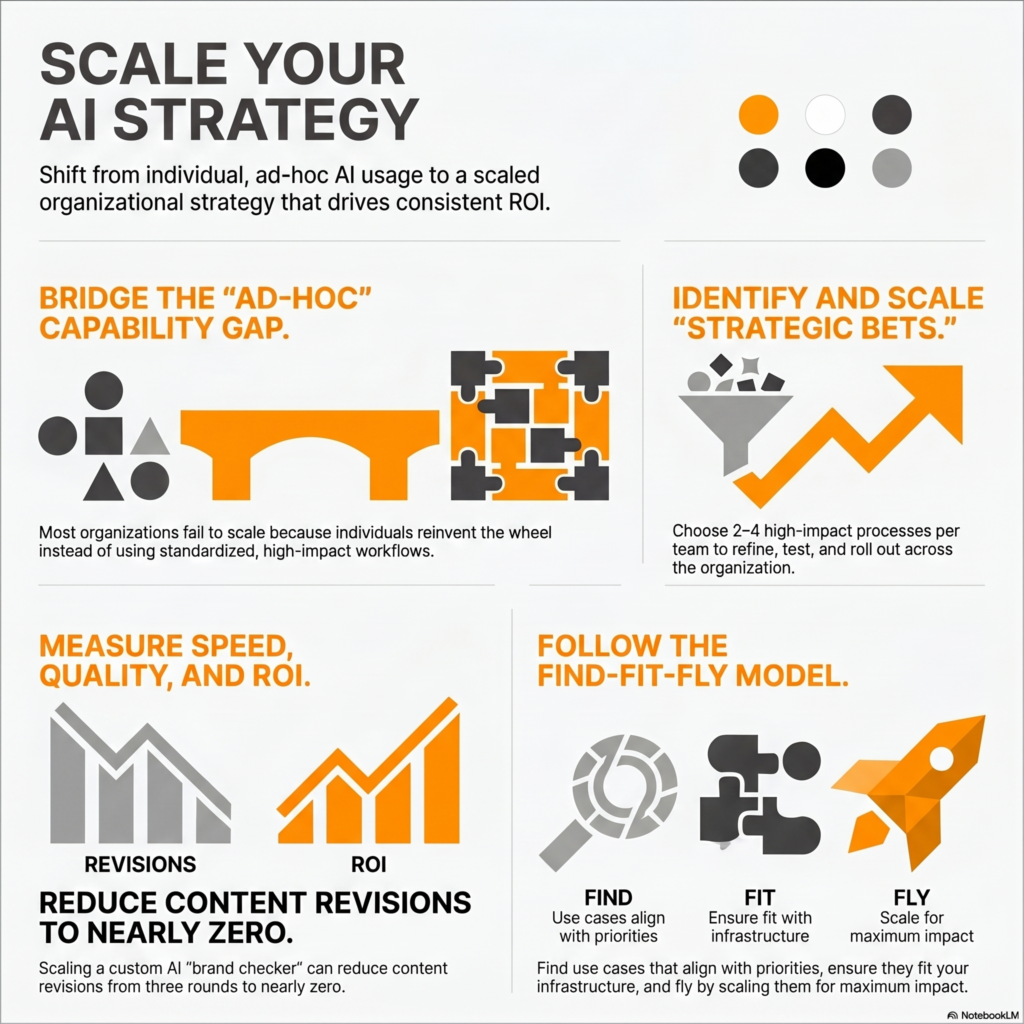
To get real results, we must move away from individual ad-hoc usage and build a structured roadmap that scales proven workflows across the company.
The 7-Step AI Strategy Roadmap
To build an AI roadmap that secures executive buy-in, you need a clear framework. Here are the 7 steps we use to build a strategic framework for AI.
1. Start with business strategy instead of AI.
Explain: Do not start by looking at an AI tool or an individual task. Look at your organization’s business priorities over the next few years and identify how AI can serve those specific goals.
Example: In a recent training workshop of 200 professionals, only one person started her plan by looking at organizational goals rather than her own daily to-do list. Anchoring AI to business goals secures leadership buy-in and resources.
2. Audit where you actually are.
Explain: Evaluate your current data, talent, tools, and company culture. Agentic AI and custom use cases require clean data and clearly documented workflows.
Example: If you have a team of sales reps who all complete tasks differently, you cannot deploy a scaled AI solution. You must streamline and document the workflow first.
3. Define your AI ambition level.
Explain: Determine exactly what you want to achieve with AI. Your ambition could be basic efficiency, employee augmentation, or full business transformation.
Example: Instead of just making a sales rep faster, a strategic ambition is to augment their workflow so they shift from spending 80% of their time on administrative work to actively selling.
4. Identify strategic bets.
Explain: Choose two to four specific processes to prioritize. Focus on use cases that solve real problems and can be scaled across multiple people.
Example: A global organization we worked with built a custom AI deployment pack focused strictly on writing in their brand tone of voice. This ensured every employee produced consistent content instead of constantly reinventing prompts.
5. Define what good looks like.
Explain: Establish clear success metrics and key performance indicators (KPIs) before you deploy AI. Know exactly how you will evaluate the outcome.
Example: If your strategic bet is to improve branded content quality, set a tangible, measurable target such as reducing cycle time or eliminating revision rounds.
6. Build an enabling foundation.
Explain: Put the required infrastructure in place to scale the technology. This includes data protocols, governance, change management, and talent capability building.
Example: You may design an AI workflow based on a highly trained power user. However, when you scale it, average users will generate poor results and waste time if you do not provide proper training and a strong foundation.
7. Create a unifying AI vision statement.
Explain: This step is completed last. Once you align your use cases with business priorities, craft a vision statement that unifies your team around what great AI usage looks like.
Example: A clear vision statement ensures everyone from power users to resistant laggards understands the organization’s goals and what is specifically expected of them.
Prioritizing Use Cases with Find-Fit-Fly
You will inevitably generate more AI ideas than you can execute. To prioritize, plot your use cases on a matrix measuring Business Impact against Cost or Investment. We focus on quick wins, which have high impact and low cost, and strategic bets, which cost more but deliver significant business value. Every approved use case must clearly tie to one of four business drivers: revenue, margin, efficiency, or performance.
To operationalize these ideas, we use the Find-Fit-Fly model.
- Find: Locate the right use cases that align with business priorities.
- Fit: Score them based on impact and cost, define KPIs, and build your initial pilots.
- Fly: Scale the successful pilot across the organization, measure the ROI, and turn it into a standard workflow.
For example, one client built a custom AI checker for social media images. Employees uploaded images to verify brand compliance before sending them to the human approval stage. This structured workflow reduced approval times from two weeks and three revisions to almost zero revisions, massively accelerating their speed to execution. We do not need to overcomplicate use cases; simply saving twenty minutes a day across a whole team creates a massive organizational impact.
The Measurement Hierarchy for AI
Many AI initiatives fail because organizations use the wrong measurement approach. If you only track final financial goals, you will abandon projects too early because revenue impact takes time to materialize. If you only track leading indicators like tool logins, you cannot prove real business value.
You must measure your AI roadmap using a three-tiered hierarchy:
- Leading Indicators: Track user adoption, tool utilization, and digital fluency scores.
- Operational Metrics: Measure cycle time reduction, hours saved, and improved output quality.
- Financial Outcomes: Track tangible cost savings, productivity savings, and concrete revenue growth.
Using all three levels ensures you can prove immediate progress while securing long-term executive support. When presenting an AI roadmap to leadership, always clearly quantify what it is going to deliver in these terms. To win with AI, you must move past isolated tactics. Use these frameworks to build a scaled strategy, align it with your business goals, and deliver measurable results.