
If you’ve spent any time working with AI, you’ve probably seen how much the quality of the response can vary. One prompt gives you exactly what you need. Another gives you something generic, focuses on the wrong information, or leaves you wondering why AI completely missed the point.
Often, the difference comes down to the information AI had to work with. Details that seem obvious to you aren’t necessarily obvious to AI. It doesn’t automatically know your audience, what you’re trying to accomplish, which information matters most, or what a useful finished result looks like.
That’s where prompt optimization comes in. You can improve your results by giving AI better information and clearer direction, then evaluating what it produces and refining your approach. The B.R.I.E.F. framework gives you a practical way to think through what information will actually help.
Summary
- What Is the B.R.I.E.F. Prompting Framework?: Learn the five elements that help you give AI clearer direction.
- Background: Give AI the Context It Needs: Share the information AI needs to understand your situation.
- Request: Be Clear About What You Want: Define the task so AI knows what to produce.
- Intent: Explain What You Are Trying to Accomplish: Help AI understand the purpose behind your request.
- End Result: Define What Good Looks Like: Set expectations for the finished output.
- Focus: Shape the Details That Matter Most: Add priorities, tone, constraints, and other important direction.
- Improve Your Prompts Based on the Output: Use AI’s response to figure out what to clarify or change.
- Avoid Over-Prompting: Give AI useful context without burying the task in unnecessary information.
- Use Critical Thinking to Get Better AI Results: Evaluate what AI gives you and determine what it needs next.
What Is the B.R.I.E.F. Prompting Framework?
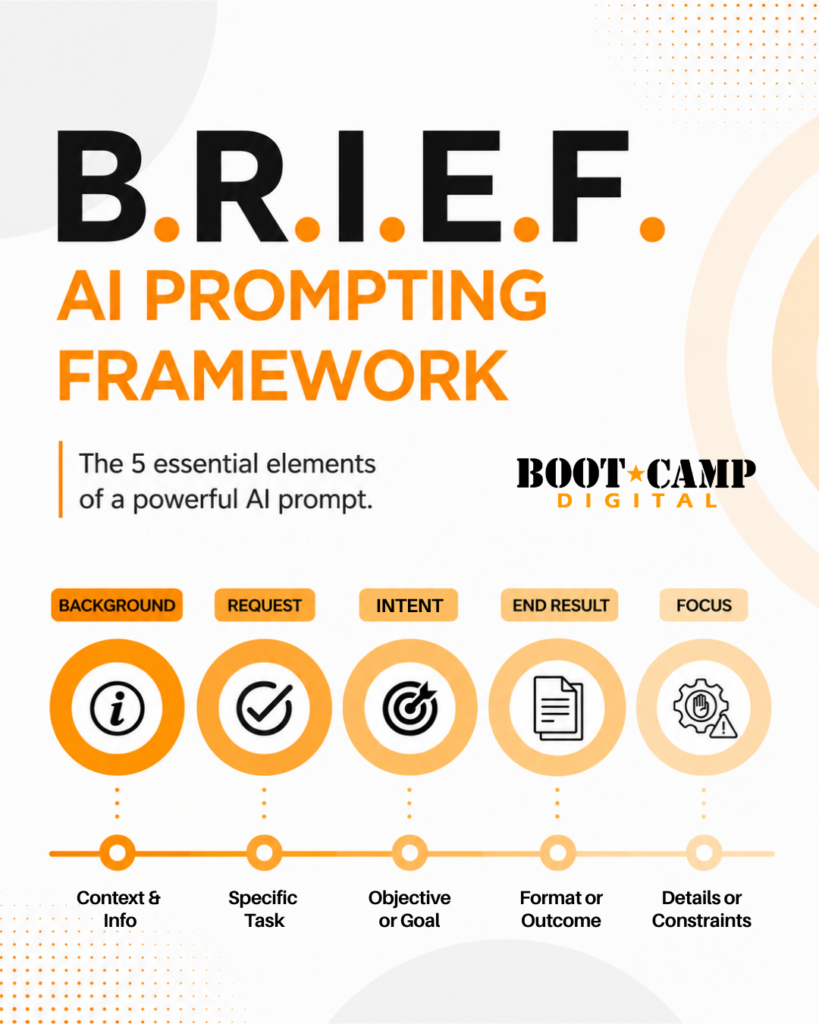
B.R.I.E.F. stands for Background, Request, Intent, End Result, and Focus. These five areas help you think through what AI needs to understand the task and produce a useful response.
You won’t need every possible detail for every prompt. A simple request may only need a clear task and a little context. More complex work could require information about your business, audience, goals, desired format, and brand. B.R.I.E.F. gives you a way to identify those needs instead of trying to remember a long list of prompting tricks.
The framework is also useful when the first response isn’t what you expected. You can go back through the five elements and ask where the disconnect happened. Maybe AI didn’t have enough background, or your request left too much room for interpretation. You may have explained what you wanted AI to create without explaining what you wanted that content to accomplish.
Background: Give AI the Context It Needs
Background is the relevant information AI needs to understand your situation. Depending on the task, this could include information about your business, target audience, existing work, examples, data, or other context that influences the result.
Imagine you ask AI to “write a LinkedIn post about our new course.” It can complete the task, although it has to make quite a few assumptions along the way. It doesn’t know who the course is for, what makes the course relevant to that audience, what those people already know about the subject, or how your brand typically communicates.
Adding some of that background gives AI a stronger starting point. You could explain that the course is designed for business professionals who already use AI but struggle to get consistent results. That one detail gives AI useful information about the audience and their existing level of knowledge.
You can use the basic who, what, when, where, why, and how to identify useful background. You don’t need to answer all of them every time. Think about which answers would actually change the response.
Request: Be Clear About What You Want
Your request is the task you want AI to complete. The clearer you are about that task, the less AI has to decide on its own.
“Give me some ideas for a presentation” leaves almost everything open. How many ideas do you need? Are you looking for topics, individual slides, or complete presentation concepts? Who is going to see the presentation? How detailed should the response be?
A stronger request might ask for five slide concepts for a beginner-level presentation about using AI at work, with a headline and a short explanation for each slide. Now AI has a much clearer assignment.
You can strengthen a request by specifying the number of outputs or options you want, the depth you expect, or an example of the type of result you have in mind. Think about what you would tell another person if you were handing them the same assignment. If that information would help them understand what you need, it may help AI too.
Intent: Explain What You Are Trying to Accomplish
Two people can ask AI to create the same type of content and need completely different results because their goals are different. Intent tells AI what you’re trying to accomplish with the output.
Say you want AI to write an email about an upcoming training. An email designed to generate registrations needs to communicate differently from one sent to people who already registered. The topic may be identical, while the purpose of the message changes what information deserves attention.
Your intent could include your business goal, what you want the audience to understand, the desired call to action, or how you plan to use the finished work. You might also explain the role you want the content to play within a larger campaign or project.
This is an easy part of prompting to overlook because the intent is already clear in your own head. Making it explicit gives AI information it otherwise has to guess.
End Result: Define What Good Looks Like
You probably have expectations for the finished result before you ever type the prompt. Tell AI what they are.
The end result can include the format, length, structure, medium, level of depth, or specific formatting rules. If you need a 150-word email, include that. If you want the information organized into a table, specify the table. When the content needs to follow an existing brand format, give AI those requirements too.
Pay attention to the changes you repeatedly make after AI gives you an answer. They can tell you what belongs in your future prompts. If you always shorten AI’s responses, start defining the length upfront. If you spend time reorganizing the information, explain the structure you need before AI begins.
Giving AI a clear picture of the finished result makes it more likely that the response will be something you can actually use.
Focus: Shape the Details That Matter Most
Focus is where you identify the details that should shape the response. You may have given AI plenty of context and a clear assignment, yet there are still decisions it needs to make about how to approach the work.
Depending on the task, useful focus details could include:
- The main message or unique selling proposition
- Tone of voice and style references
- Keywords or specific language to include
- Content type and point of view
- Constraints or requirements
- Common errors you want AI to avoid
For example, you could tell AI that the main message of a social post should be saving time, the audience already understands the basics of AI, and the tone should be practical and direct. You might also tell it to avoid hype or overly promotional language.
These details become especially useful when an AI response is technically correct but still doesn’t feel right. The problem may not be the information itself. AI may simply be emphasizing the wrong part of it or presenting it in a way that doesn’t fit your needs.
Improve Your Prompts Based on the Output
Even a detailed prompt may not give you exactly what you need on the first try. The initial response gives you new information to work with because now you can see how AI interpreted your request.
Look at the result and identify what worked before deciding what to change. If the content is too generic, you may need stronger background or more specific focus details. If AI went in the wrong direction entirely, look at your request and intent. When the information is useful but the deliverable is wrong, your end-result instructions may need more detail.
You can also reformulate your prompt, break a larger request into smaller tasks, or ask for another perspective. If you genuinely don’t know what is missing, ask AI what additional information would help it complete the task more effectively.
This is why prompt optimization requires critical thinking. You are using the output to diagnose the problem and make a more informed decision about what to provide next.
Avoid Over-Prompting
Once you see how much context can improve AI results, it’s tempting to keep adding more. A longer prompt isn’t automatically a stronger prompt.
Too much information can make it harder for AI to identify what matters. Your complete company history probably isn’t necessary for a short customer email, while your audience, purpose, and main message could have a significant impact on the result.
Before adding another piece of context, ask whether it will meaningfully affect the output. If it won’t, you can probably leave it out. B.R.I.E.F. is meant to help you provide the right information for the task, rather than every piece of information available to you.
Use Critical Thinking to Get Better AI Results
Prompt optimization isn’t about memorizing a perfect formula. Your experience and judgment still matter because you understand your business, audience, goals, and standards in ways AI does not.
When a response misses the mark, get specific about why. Maybe the tone was wrong because AI didn’t have examples of your voice. Maybe it emphasized a minor product feature because you never identified the main message. The response could be far too detailed because you didn’t explain how the final content would be used.
Once you identify where the response went wrong, you can give AI better direction. Over time, this also helps you recognize which types of context make the biggest difference for the work you do most often.
The goal isn’t to spend more time writing enormous prompts. You want to get better at identifying what AI needs from you, communicating it clearly, and evaluating what comes back. B.R.I.E.F. gives you a simple framework to do that consistently.
FAQs About the B.R.I.E.F. AI Prompting Framework
What does B.R.I.E.F. stand for in AI prompting?
B.R.I.E.F. stands for Background, Request, Intent, End Result, and Focus. These five elements help you identify the information AI may need to understand your task and produce a useful response.
Do you need to include every part of B.R.I.E.F. in every prompt?
No. The amount of information you need depends on the task. A simple request may require very little context, while complex work may benefit from more detailed background, goals, formatting requirements, and focus instructions.
What should you include as background in an AI prompt?
Include context that affects how AI should complete the task. This may include your audience, business context, examples, relevant data, existing materials, or information about the situation.
What is the difference between request and intent in an AI prompt?
The request tells AI what you want it to do. Intent explains what you want to accomplish with the result. Providing both can help AI understand the assignment and the purpose behind it.
How do you tell AI what the end result should look like?
Describe the format, length, structure, medium, level of detail, and any relevant formatting requirements. Think about what you would need to receive for the output to be immediately useful.
How much context should you give AI?
Provide the context that meaningfully affects the task. Adding unrelated information can make a prompt less focused, so consider whether each piece of context will change or improve the response.
What should you do when an AI prompt gives you a poor result?
Identify the specific problem with the response before changing your prompt. Then determine whether AI needs better background, a clearer request, more information about your intent, stronger end-result requirements, or additional focus details.