
Summary
- What Should You Learn in an AI Certification? Evaluate two buckets: what it teaches, and how it teaches it.
- Is the Topic Covered Comprehensively? A 5-minute video on a topic isn’t training. Check the depth, the breadth, and the learning path.
- Is the Content Practical, Not Theoretical? Talking the talk isn’t the same as walking the walk. Look for demos, instructor support, and templates.
- Do the Learning Objectives Match Your Goals? Beginner, intermediate, or advanced, the right fit depends on where you actually are.
- Does It Work With the AI Tools You Actually Use? You don’t need a dozen subscriptions. Look for training that works across the tools you already have.
- Is It Built on Strategy, Not Hacks? Skip the shiny objects. Build real AI muscle instead of copying prompts that don’t work.
- Does It Use Live Demonstrations? Slides and screenshots won’t teach you the tool. You need to see it in action.
- Does It Teach Repeatable Methods, Not Random Ideas? One person’s personal tips aren’t a framework. Look for proven methods you can use every time.
- Does It Give You Proven Templates, Not Just Suggestions? A suggestion is a starting point. A template is something you can actually use today.
- Does It Require You to Apply What You Learn? No demonstration, no proof. Check whether the program makes you use the skill, not just hear about it.
- Ready to Choose What to Learn? How the AI Master Certifications are built around both content and approach.
What Should You Learn in an AI Certification?
What should a certification actually cover so you know it’s worth it and going to get you results?
Evaluate two buckets. The first is content coverage: what you’re actually learning. The second is the learning approach: how you’re learning it. Get both right, and you’ll know within minutes whether a program is worth your time.
Is the Topic Covered Comprehensively?
Check the depth and breadth first. If there’s one 5-minute video on a topic like tone of voice, that’s not enough to actually build a strong tone of voice with AI. A single video is a preview, not training.
Look at the program’s learning objectives. Check how long it is. Check how much time it spends on the topics you care most about.
Here’s the real test: is this a comprehensive learning path building toward a clear outcome, or a random collection of topics with no connection between them? You want a path that moves you from A to B, not a grab bag.
Is the Content Practical, Not Theoretical?
Theoretical content wastes your time. You end up able to talk the talk, but not walk the walk. That doesn’t help you at work.
Check for three things. Does the program include product demos? Is there instructor support to help you apply what you’re learning? Do they give you templates and tools, or just information?
If a program talks about ideas without giving you tangible tips, demonstrations, and tools to implement them, skip it. You want practicality, not broad ideas you can’t use.
Do the Learning Objectives Match Your Goals?
Check the learning objectives against what you actually want to get out of the program. This matters more than most people realize.
Whether you’re a beginner, intermediate, or advanced user changes which certification is right for you. Read the learning objectives, and be honest about where you currently are. The right fit depends on tying those objectives back to your own goals, not the program’s marketing.
Does It Work With the AI Tools You Actually Use?
Check whether the program works within your existing AI toolkit. You don’t need a dozen subscriptions to use AI effectively. You don’t need to pay for a wall of shiny tools you’ll never actually use.
It helps when a program covers multiple tools so you understand what’s out there. But the real requirement is that it works with the tools you already use.
At Boot Camp Digital, our AI training is tool agnostic. It works whether you’re using Claude, ChatGPT, Copilot, or Gemini, because these platforms work in similar ways, and our training is built to be universal across them. Check that any program you’re considering is relevant to your own toolkit, not built around one company’s product.
Is It Built on Strategy, Not Hacks?
Look for high-quality strategic and tactical foundational materials, not hacks or shiny objects.
So much AI content out there is about making a video of yourself walking through Times Square with a dragon, or a templated hack you’re told to copy and paste for instant results. Here’s the truth: that’s not how AI works. Copy and paste prompts rarely get you good results anyway.
A certification should build your AI muscle, not hand you random prompts to imitate. Look for serious strategic thinking about how to teach, implement, and get results from AI, not a stream of shiny objects designed to look impressive in a demo.
Does It Use Live Demonstrations?
Now check the learning approach. The real question here is whether this approach will grow your skills, or just transfer knowledge at you.
Start with live demonstrations. You need to see these tools in action to actually understand how they work and how to optimize them. Flipping through slides, talking theoretically, or showing static screenshots won’t cut it. If the training isn’t showing the tool live, on screen, doing the thing, keep looking.
Does It Teach Repeatable Methods, Not Random Ideas?
Check whether the program gives you repeatable methods or just random ideas. A lot of training is someone who knows a topic telling you about it.
The problem with that approach is these are often personal ideas that worked for one person once, not something packaged into a repeatable method you can actually use. Look for proven frameworks you can apply consistently, not a personal highlight reel.
Does It Give You Proven Templates, Not Just Suggestions?
Check for proven templates versus suggestions. A lot of training shows you what worked for someone else here and there, a jumble of ideas and tips without structure. That won’t comprehensively build the AI muscle you need.
What you need instead is proven templates: things you can take and use immediately to improve the results you’re getting from AI. A suggestion is a starting point. A template is something you can put to work today.
Does It Require You to Apply What You Learn?
Check for opportunities, or requirements, to apply what you’re learning. The goal of a certification is to demonstrate that you know how to do something.
If a certification has no requirement or opportunity for demonstration, question the practicality of it. Look for a program that gives you real chances to apply what you learn, with instructor feedback on that application. Without that, you’re not building a skill. You’re just collecting information.
This all comes down to one thing: learning how to use AI in a realistic, practical way. Skip the hype and the hacks. Look for strategies and tactics that produce outcomes that actually matter to you, not prompts and swipe files that don’t work when you try to use them.
Ready to Choose What to Learn?
Run any certification you’re considering through both buckets: what it teaches, and how it teaches it.
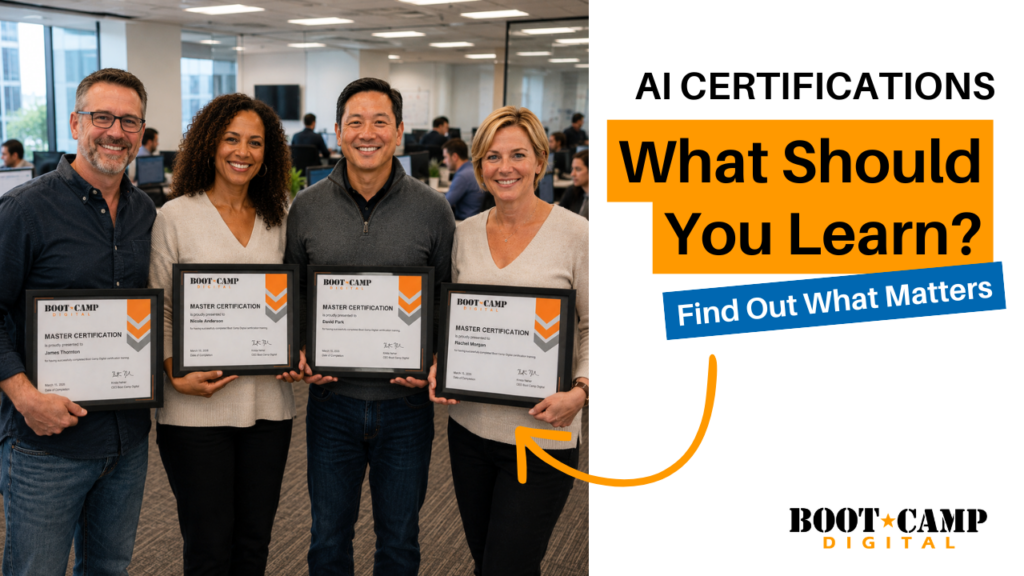
The AI Master Certifications are built around exactly this standard. You’ll get comprehensive, practical content that matches your goals, tool-agnostic training that works across ChatGPT, Claude, Gemini, and Copilot, live demonstrations, proven frameworks and templates, and real opportunities to apply what you learn with instructor feedback. Boot Camp Digital has trained professionals for more than 20 years, with clients including Meta, Google, and Nike.
Take a look at the AI Master Certifications and start building the kind of AI muscle that actually shows up in your results.
Frequently Asked Questions
What should an AI certification actually teach?
Look for comprehensive, practical content that matches your skill level, works with the AI tools you already use, and is built on strategy rather than hacks or shiny objects.
What learning approach should a good AI certification use?
Look for live demonstrations instead of slides, repeatable methods instead of random personal tips, proven templates instead of vague suggestions, and required opportunities to apply what you learn with instructor feedback.
Why does it matter if an AI certification is tool agnostic?
Major AI tools like ChatGPT, Claude, Gemini, and Copilot work in similar ways. Training that’s tool agnostic works with the tools you already use, so you don’t need multiple subscriptions just to apply what you learned.