
Digital marketing is always changing. New technologies, platforms, and tools create opportunities for marketers to reach customers and get better results. As we look ahead to 2027, AI is driving many of the biggest changes, but there are also important shifts in how people discover brands, engage with content, and make purchasing decisions.
The challenge is knowing which trends deserve your attention.
One of the biggest mistakes I see marketers make is chasing new trends while overlooking the fundamentals that actually drive business results. A well-functioning website, strong content, and a consistent strategy may not be as exciting as the latest AI tool, but they are essential to success.
The key to digital marketing success in 2027 is understanding what’s changing and adapting your strategy without losing focus on what already works.
Here are the biggest digital marketing trends to watch and what they mean for your business.
Summary
- Focus on Performance Metrics That Drive Business Results: Prioritize meaningful business outcomes over traffic, followers, and activity.
- Authentic Content and Human Connection Matter More Than Ever: As AI-generated content increases, real human experiences and authentic content become more valuable.
- Digital Advertising Is Becoming More Automated: AI is taking over more advertising decisions, making creative and first-party data increasingly important.
- Interactive Experiences and Social Commerce Are Growing: Interactive lead magnets and shoppable content create new opportunities to engage customers.
- AI Is Changing How Customers Discover and Buy: AI search and shopping assistants are changing how businesses get recommended and how consumers make purchasing decisions.
- AI Is Changing How Marketing Gets Done: AI agents and autonomous workflows are creating opportunities to complete marketing tasks faster and more efficiently.
- Do Less, Better: Focus on What Actually Works: Concentrating resources on your strongest marketing activities can generate better results than trying to do everything.
- FAQs About Digital Marketing Trends for 2027: Answers to common questions about preparing your marketing strategy for 2027.
Focus on Performance Metrics That Drive Business Results
One of the biggest changes marketers need to make in 2027 is rethinking how they measure success.
For years, digital marketing has focused heavily on quantity metrics.
How much website traffic did you get? How many social media followers do you have? How many emails did you send?
These numbers can provide information, but they don’t necessarily tell you whether your marketing is working.
What matters is what people actually do.
For example, a website with thousands of visitors may be less valuable than one with fewer visitors who consistently complete forms or make purchases.
The same is true for email marketing. Sending emails consistently is an activity. Getting people to click, engage, and take meaningful action is a result.
Focus on metrics such as:
- Website conversions and completed forms.
- Products added to carts and purchases.
- Leads generated from marketing campaigns.
- Actions taken after clicking an email.
- Advertising results relative to your investment.
Other metrics can still help you identify problems or understand performance. The key is making sure your primary measures of success connect to business results.
AI can also help you analyze your marketing data.
Instead of simply collecting reports, use AI to identify patterns, understand what’s working, and make more informed decisions about where to invest your resources.
Authentic Content and Human Connection Matter More Than Ever
As AI-generated content becomes easier to produce, we’re seeing more AI-created images, videos, and advertising.
Some brands are embracing this technology without considering whether the content actually connects with customers.
I’ve seen major brands use AI-generated people in advertisements designed to create an emotional connection. The problem is that the emotion doesn’t always come through. The content may look polished, but it can feel unnatural.
This creates an opportunity for businesses that focus on real human connections.
Authentic content has been effective in marketing for years. Think about the growth of user-generated content, real customer photos, and unpolished social videos.
People connect with real experiences.
As more businesses produce AI-generated content, authentic human content can help your brand stand out.
Consider using:
- Real photos of your products, customers, and employees.
- Videos featuring actual people sharing experiences or expertise.
- Customer stories and user-generated content.
- Less polished, more natural social media content.
You don’t necessarily need expensive production to create effective content. Sometimes an authentic video recorded on a phone can communicate your message more effectively than a highly produced advertisement.
Influencer and Creator Marketing Continue to Grow
Influencer and creator marketing also provide opportunities to connect with customers more naturally.
When creators incorporate products into their everyday content, recommendations can feel more relevant than traditional advertising.
You don’t need to work with major influencers to benefit from this approach. Smaller creators and business partnerships can also help you reach relevant audiences.
Look for opportunities to work with people or organizations that already have relationships with the customers you want to reach.
The important thing is making sure the partnership feels natural and relevant to your audience.
Digital Advertising Is Becoming More Automated
Digital advertising platforms have been incorporating machine learning and AI for years. Now, more decisions about targeting, placements, and optimization are being handled automatically.
Platforms increasingly ask advertisers to provide their objective, budget, and creative, then allow the system to optimize delivery.
This changes where marketers should focus their attention.
Historically, advertisers spent significant time creating small audiences, adjusting targeting, and managing placements. As these processes become more automated, your advertising creative becomes one of the biggest opportunities to improve performance.
If the platform is making more of the delivery decisions, the quality of your message and creative becomes increasingly important.
Spend more time developing, testing, and improving different creative approaches. Look at which messages, images, and videos generate the strongest results.
First-Party Data Becomes More Valuable
Another important advertising trend is the growing importance of first-party data.
First-party data is information your business collects about its own customers and audiences.
As tracking becomes more challenging and less effective, having access to your own audience information becomes increasingly valuable.
This includes understanding who visits your website, how they interact with your business, and how you can reconnect with relevant audiences.
Review your tracking and analytics setup to make sure you’re collecting useful information and can use it to support your marketing efforts.
Interactive Experiences and Social Commerce Are Growing
Another shift worth watching is how businesses engage customers and create opportunities for them to take action.
AI is changing the value of traditional informational content.
If someone wants general information about a topic, they can now ask AI to create a customized answer based on their specific needs.
This means traditional informational lead magnets, such as ebooks and downloadable reports, may become less effective.
One opportunity is to create interactive lead magnets that provide personalized value.
Examples include:
- Quizzes that assess someone’s knowledge or skills.
- Assessments that identify areas for improvement.
- ROI calculators that estimate potential returns.
- Interactive tools that provide personalized recommendations.
At Boot Camp Digital, our Digital IQ Test has consistently been one of our strongest lead magnets.
People answer questions about their digital marketing knowledge and receive results that help them understand their skill level. Those results can also guide them toward relevant training.
The value comes from the personalized experience.
Rather than simply providing information, you’re helping someone learn something specific about themselves or their situation.
Social Commerce Makes Shopping Easier
Another trend to watch is the continued growth of social commerce and shoppable content.
Platforms like TikTok, Pinterest, and Amazon are making it easier for people to discover products and purchase them directly through content.
Live shopping experiences are also creating opportunities to demonstrate products and connect shopping with entertainment.
For businesses selling physical products, these experiences are worth exploring.
Think about how you can make it easier for customers to move from discovering a product to purchasing it, especially when they’re already engaging with content.
AI Is Changing How Customers Discover and Buy
While many of the fundamentals of marketing remain the same, AI is creating some significant changes in how customers find businesses, compare options, and decide what to purchase.
Two important areas to understand are Generative Engine Optimization (GEO) and Answer Engine Optimization (AEO). Both focus on improving how your business appears in AI-generated answers and recommendations.
Traditional SEO often starts with a website and a keyword search. AI searches can be much more specific.
For example, someone searching Google for a wedding DJ might enter a simple query like “wedding DJ near Boca Raton.”
When using AI, that same person can explain their budget, the type of music they want, the age of their guests, and other specific requirements.
I recently tested this example and found something surprising. The top DJ recommended by AI didn’t even have a website.
Instead, AI used information from reviews and other online sources to identify a business that matched the specific requirements.
This highlights an important change: Your entire online presence matters when it comes to AI recommendations.
Your website is still important, but AI can also consider customer reviews, business profiles, and information published elsewhere online.
To improve your visibility in AI search:
- Provide detailed information about your products and services.
- Include information that addresses specific customer needs and questions.
- Make pricing or pricing ranges available when appropriate.
- Build a strong online presence beyond your website.
- Encourage detailed customer reviews that describe actual experiences.
AI Shopping Is Changing Purchase Decisions
AI is also becoming more involved in shopping.
Consumers can use AI assistants to compare products, build shopping lists, evaluate options, and even add products to their carts.
I’ve used AI to help plan meals, identify recipes, and add the necessary ingredients to an online shopping cart. I still review everything and complete checkout myself, but AI handles much of the research and preparation.
I’ve also used AI to research an interactive whiteboard for my recording studio. It helped compare specific products based on the features that mattered most to me.
For businesses, this means product information and customer reviews are becoming even more important.
AI needs enough information to understand what makes your product a good fit for a particular customer. If important details aren’t available online, your product may be overlooked.
AI Is Changing How Marketing Gets Done
AI has already changed how marketers create content, research ideas, and complete everyday tasks. The next big opportunity is moving beyond individual AI prompts and into agentic AI and autonomous workflows.
Instead of using AI to complete one task at a time, marketers can build workflows that handle multiple steps of a process. AI can execute tasks, test results, and complete work that previously required significant time or specialized knowledge.
For example, I recently used an AI agent to overhaul our advertising tracking system. The agent helped set up tracking across our advertising platforms and Google Analytics, executed the changes, and ran tests. My role was to provide direction, review the work, and make adjustments when needed.
This is where AI becomes especially valuable.
You can also use AI to take on tasks that previously depended heavily on your own expertise. For example, creating course descriptions or learning objectives requires a strong understanding of the content. By providing AI with the right information, instructions, and examples, you can train it to complete more of that work while maintaining your strategic direction.
What should you do?
Start identifying repetitive processes or tasks that depend heavily on your time. Consider which activities could be supported by AI agents or automated workflows.
The goal is to use your expertise to guide AI so you can accomplish more without personally executing every step.
Do Less, Better: Focus on What Actually Works
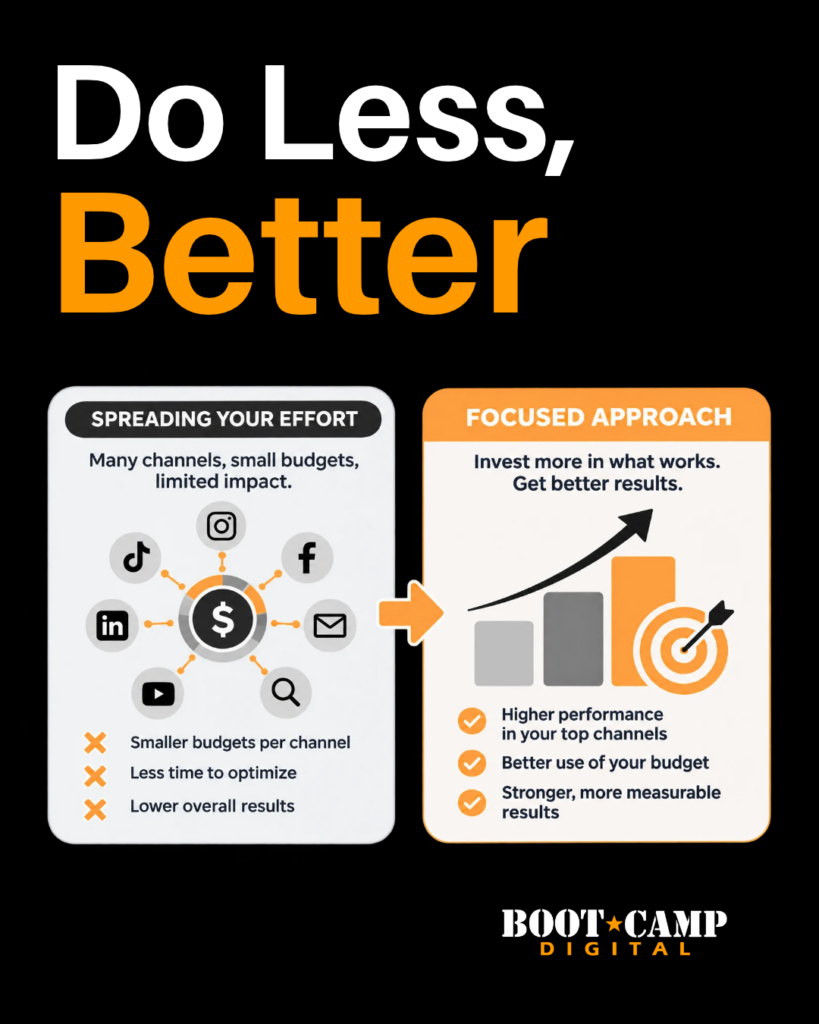
One of the biggest challenges I see across businesses of all sizes is trying to do too many things.
Marketers spread their budgets across multiple advertising platforms, social networks, and campaigns without giving any one activity enough attention to perform well.
I’ve reviewed advertising plans from major brands running campaigns across numerous platforms, but with budgets too small to gain meaningful traction on any of them.
More marketing activity doesn’t automatically mean better marketing results.
As digital platforms become more complex, it takes more effort and expertise to use them effectively.
Instead of trying to be everywhere, identify your strongest opportunities and invest more heavily in them.
Ask yourself:
- Which marketing channels generate the most meaningful business results?
- Which campaigns or activities are consistently performing well?
- Where are you spending time or money without seeing results?
- What could improve if you focused more resources on your strongest performers?
For example, if one advertising channel consistently generates leads at a reasonable cost, improving that campaign may be more valuable than launching campaigns across several additional platforms.
The same principle applies to content, SEO, email marketing, and social media.
You should continually review your data, improve your strongest activities, and stop investing in things that aren’t producing results.
What Should You Prioritize in 2027?
There are plenty of new technologies and opportunities to explore, but successful digital marketing still comes down to a few important fundamentals.
Understand your customers and what they need. Create content and experiences that connect with them. Use data to understand what’s working and make better decisions.
AI can help you work faster, analyze information, and improve execution. New shopping experiences and discovery tools can help you reach customers in different ways.
But these opportunities should support your strategy, not distract you from it.
As you plan for 2027, focus on improving what already drives results while selectively investing in the trends that can make your marketing more effective.
Doing a few things exceptionally well will often generate better results than trying to do everything.
FAQs About Digital Marketing Trends for 2027
1. What are the biggest digital marketing trends for 2027?
Some of the biggest trends include agentic AI and autonomous workflows, AI search optimization, AI shopping, authentic content, automated digital advertising, first-party data, interactive lead magnets, and social commerce. Marketers should also focus more heavily on performance measurement and prioritizing their strongest marketing activities.
2. How will AI change digital marketing in 2027?
AI is changing both how marketers work and how customers interact with businesses. Marketers can use AI agents and autonomous workflows to complete complex tasks, while consumers increasingly use AI to research products, compare options, and make purchasing decisions.
3. What is GEO and AEO in digital marketing?
GEO stands for Generative Engine Optimization, while AEO stands for Answer Engine Optimization. Both focus on improving how businesses appear in AI-generated answers and recommendations. This includes providing detailed business information, building a strong online presence, and maintaining useful customer reviews.
4. Why is authentic content important in 2027?
As AI-generated content becomes more common, authentic content helps businesses build trust and connect with customers. Real photos, customer experiences, and videos featuring actual people can create stronger human connections than generic AI-generated visuals.
5. What should marketers prioritize in their 2027 digital marketing strategy?
Marketers should prioritize the activities that generate meaningful business results. Start by reviewing performance data, identifying your strongest channels, improving your creative and customer experience, and exploring AI tools that can make existing processes more effective.