
I’ve recently talked with about a dozen executives from a Fortune 500 company about how they use AI, how their organization uses it, and where they want to take it next. Their tools and goals vary, but a recurring challenge remains: employees are finding useful ways to work with AI, yet those individual wins are difficult to translate into value across the organization.
I’ve been training people on AI for more than four years. In most organizations, I no longer have to make the case that employees will try it. They already are. The harder work is helping more people use it well, finding where it belongs in their jobs, and changing how teams operate as they learn.
Buying a tool can give people access. Scaling adoption takes a plan for what happens after they log in.
Summary
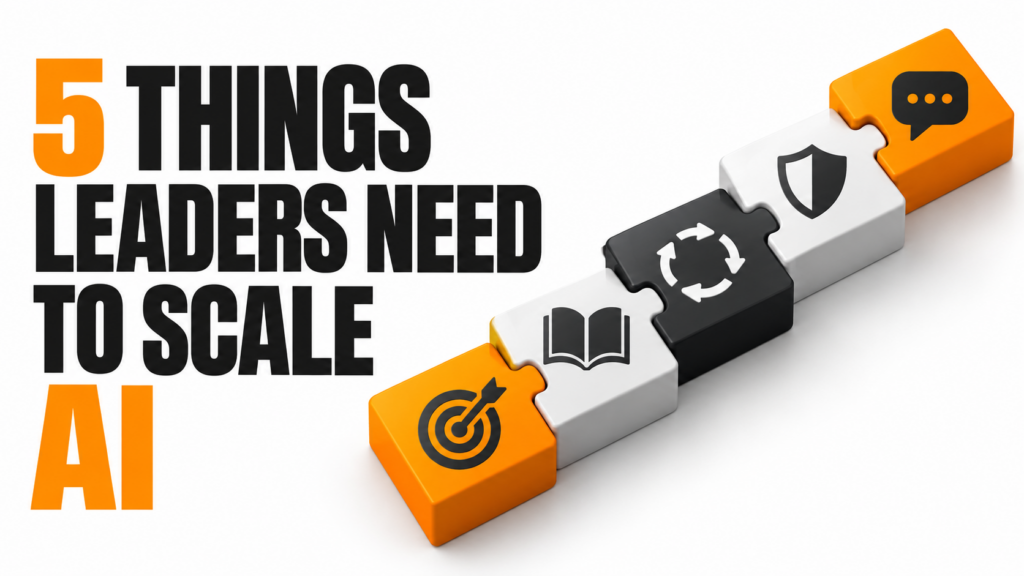
- Agree on the purpose: Define why the organization is investing in AI and how it will judge progress.
- Train people for the work they do: Build common skills and give employees practice in their roles.
- Redesign workflows: Examine the full process instead of adding AI to one step.
- Make governance usable: Give employees clear boundaries and a way to get answers.
- Reinforce the change: Keep communicating as people learn and their work evolves.
- Questions for leaders: Identify where adoption may be getting stuck.
- FAQs about scaling AI adoption: Get direct answers to common implementation questions.
1. Agree on the purpose
Leaders need to be able to explain what AI is meant to improve. “We want people to use AI” is a starting ambition, but it gives teams little help in deciding where to focus.
Choose specific goals that connect to the work. Do you want to reduce the time spent preparing routine reports? Help teams find and use internal knowledge? Improve the speed of developing a first draft while maintaining quality? Those aims point to different training, processes, and measures of success.
Alignment also matters across functions. If one leader is asking employees to experiment while another rewards them for following the old process exactly, people receive mixed signals. Agree on the priorities and the standards before asking teams to change their habits.
2. Train people for the work they do
Most employees need more than a demonstration of an AI tool. They need to know how to give it useful direction, decide whether the result is any good, and apply it within their organization’s rules.
Start with a common foundation so people share basic skills and language. Then make the learning relevant to their roles. A salesperson preparing for a customer conversation, a marketer developing a campaign, and a manager reviewing a team’s work need different practice.
Some organizations require training to retain an AI tool license. That can ensure people complete the basics, but course completion alone does not show that their work has changed. Give employees opportunities to apply what they learn to real tasks, get feedback, and return with questions after they have tried it.
3. Redesign workflows
AI can make an individual step faster while leaving the rest of a process untouched. Someone may draft a report in less time, for example, only to wait for the same handoffs and approvals that caused delays before.
Look at the entire workflow. Where does information come from? Who makes decisions? Which steps are repeated? What needs review? Then decide where AI can help and whether any steps should change.
This takes input from the people doing the work. Ask them to show you the current process, including the workarounds that rarely appear in a process document. Test a revised approach on a real task and examine both the result and the effort it took to produce it.
4. Make governance usable
Employees need to know what they can use AI for, what information they can enter, and how to review what comes back. Clear rules give them room to try useful applications without having to guess where the boundaries are.
Make the guidance easy to apply. Include examples of approved and restricted uses, expectations for checking output, and a place to ask questions. If the policy lives in a document nobody can interpret during a workday, it will not provide much support.
Governance should also respond to what teams learn. New use cases will raise questions your initial guidance did not cover. Give those questions an owner and a route to an answer.
5. Reinforce the change
One launch announcement will not carry an organization through a change in how it works. Leaders and managers need to keep explaining the priorities, showing useful applications, and listening to what employees find difficult.
Make progress visible. When a team improves a process, share what it did and what still requires human judgment. When an approach does not work, explain what the team learned. These examples are more useful than repeatedly telling employees that AI is important.
As tools and practices change, update the training and resources people rely on. Adoption grows through repeated use, feedback, and improvement.
Questions for leaders
If AI use is growing but its impact is unclear, start with a few questions:
- Can leaders describe the same priorities for AI and what success would look like?
- Do employees know how to use the approved tools effectively in their daily work?
- Have teams changed any workflows, or are they doing the same work with an AI step added?
- Can employees easily find the rules and get answers to questions?
- Are managers sharing useful examples and helping people put new skills into practice?
The answers can help you see which part of your approach needs attention first. You may have the right tools but need stronger training. You may have skilled employees whose best practices have not spread beyond their teams. Or you may need to revisit a workflow that limits the value people can get from AI.
Individual experimentation gives you a place to begin. To scale AI adoption, connect those efforts to clear goals, practical skills, workable rules, and better ways of doing the work.
Working on AI training for your organization? Email [email protected] to explore options for your team.
FAQs about scaling AI adoption
What does scaling AI adoption mean?
It means helping AI become a useful, repeatable part of work across relevant teams. The focus is on how people apply it and the value it creates, rather than the number of people who have access to a tool.
Why doesn’t giving employees AI tools lead to widespread adoption?
Access does not teach employees where AI fits in their jobs, what information they can use, or how to judge the output. Training, clear guidance, and changes to workflows help close those gaps.
Should AI training be required for employees with licenses?
Required training can establish a common foundation and clarify the rules for using a tool. It works best when employees also practice on relevant tasks and can get help as they apply what they learned.
How can leaders identify workflows worth changing with AI?
Start with a process that matters to the team. Map its steps, delays, decisions, and review points with the people who do the work. Test a revised process and compare the time required and quality of the result.
How do you measure AI adoption?
Look beyond logins and course completions. Examine whether people use AI for appropriate tasks, whether the quality of work holds up, and whether a revised process saves time or improves an outcome the organization cares about.