

AI search is changing how people find businesses, compare options, and make decisions — and marketers need to adapt their SEO strategies now.
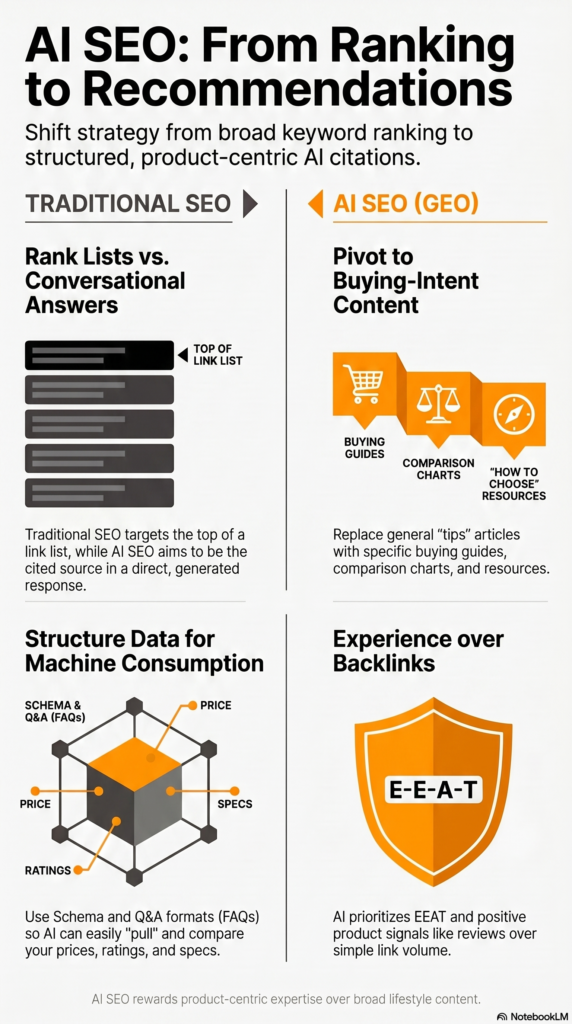
- What Is AI Engine Optimization? — AI SEO is about showing up in AI-generated answers, not just traditional search rankings.
- SEO Is Not Dead — Traditional SEO still matters, but it needs to evolve for AI search.
- How AI Search Is Different — AI search is conversational, specific, and answer-based.
- The ART of AI SEO — Authority, Relevance, and Technical optimization still matter, but AI evaluates them differently.
- Topic Clarity Beats Topic Breadth — AI rewards specific, useful content that answers buyer questions.
- AI SEO Action Plan — Use FAQs, buying guides, reviews, and off-site signals to improve visibility.
What Is AI Engine Optimization?
AI Engine Optimization is the process of improving your online presence so AI tools can find, understand, trust, and recommend your business.
You may hear this called:
- AI SEO
- Generative Engine Optimization
- GEO
- AI Search Optimization
The name doesn’t really matter.
The shift does.
For years, SEO was about showing up in Google. The goal was to get your website listed at the top of the search results.
Now, people are asking AI tools for direct answers.
They are using ChatGPT, Perplexity, Gemini, Copilot, and AI-powered search engines to make decisions.
That means the new goal is not only to rank.
The goal is to be included in the answer.
For example, someone may ask:
“What are the best running shoes for wide feet if I’m training for my first marathon?”
AI may answer with a short list of shoes, explain the pros and cons, and cite a few sources.
If you sell running shoes, you want your brand, product, or content included in that answer.
That is AI Engine Optimization.
SEO Is Not Dead
Every few years, marketers announce that something is dead.
Email is dead.
Facebook is dead.
Websites are dead.
SEO is dead.
Usually, it isn’t dead.
It just changed.
AI search is not replacing traditional SEO overnight. People will still use Google. Websites will still matter. Search rankings will still matter.
But search behavior is changing.
People are asking longer questions. They want faster answers. They expect the search tool to summarize the information for them.
This means your SEO strategy needs to do two things:
- Help you show up in traditional search results.
- Help AI tools understand and recommend your business.
The foundation of SEO still matters.
You still need useful content.
You still need a strong website.
You still need authority.
You still need clear technical structure.
But you also need to think about how AI tools read and summarize information.
BIG IDEA: AI SEO builds on traditional SEO. It does not replace it.
If your SEO foundation is weak, AI search will not magically fix it.
Start with the basics. Then adapt for AI.
For marketers who want to strengthen the foundation first, Boot Camp Digital’s SEO training courses are a practical place to start.
How AI Search Is Different
Traditional search gives people links.
AI search gives people answers.
That is the biggest difference.
In traditional search, someone types a keyword phrase like:
“red shoes wide feet”
Then they scan the results. Click links. Compare pages. Read reviews. Decide what to do next.
In AI search, the same person may type:
“I have wide feet and I’m training for a marathon. I need durable running shoes with support. What should I buy?”
That is a very different kind of search.
It is longer.
It is more specific.
It includes context.
It includes intent.
AI tools are designed to answer these kinds of questions.
So your content needs to be built for specific questions and direct answers.
This is where many businesses fall short.
Their content is too vague.
They say things like:
“We provide high-quality solutions for today’s customers.”
What does that mean?
Nothing.
It doesn’t answer a question.
It doesn’t help someone decide.
It doesn’t prove expertise.
It doesn’t give AI anything useful to cite.
A stronger version would be:
“Our beginner running shoes include a wider toe box, extra heel support, and lightweight cushioning for runners building mileage gradually.”
That is specific.
It tells the customer what matters.
It tells AI what the product is.
It connects the product to a real use case.
POWER TIP: Write the way your customer asks questions. Then answer those questions clearly.
The ART of AI SEO: Authority, Relevance, and Technical
I like to simplify SEO into three parts: Authority, Relevance, and Technical.
I call this the ART of SEO.
These three areas still matter in AI search.
But AI evaluates them differently.
Authority: Does AI Trust You?
Authority is about credibility.
In traditional SEO, authority has often been connected to backlinks. If other websites link to you, search engines see that as a trust signal.
Backlinks still matter.
But AI looks beyond links.
AI tools may consider:
- Reviews
- Ratings
- Media mentions
- Expert opinions
- Influencer reviews
- YouTube videos
- Reddit discussions
- Comparison articles
- Social media conversations
- Your website content
- Your author credibility
This is closer to how a real person makes a decision.
Think about the last time you made a big purchase.
You probably didn’t just visit the company website and believe everything they said.
You checked reviews.
You asked people.
You searched for comparisons.
You looked for complaints.
You watched videos.
AI does something similar.
It looks across the web to decide what seems credible.
This is why your reputation matters more than ever.
WATCHOUT: Your website is not the only thing AI sees.
If your website says you are the best, but reviews, forums, and third-party sources do not support that, AI may not trust the claim.
Relevance: Do You Answer the Question?
Relevance means your content matches what someone wants to know.
Traditional SEO often focused on building big topic clusters.
For example, if you sold running shoes, you might write about:
- Marathon training
- Hydration
- Stretching
- Recovery
- Race-day planning
- Running motivation
Some of this content can still be helpful.
But AI search is more focused on the actual question.
If someone asks about running shoes for wide feet, AI does not need your general article about hydration.
It needs content about shoes for wide feet.
This is where AI SEO pushes marketers to get more specific.
Your content should answer real buyer questions.
Examples:
- How do I choose running shoes for wide feet?
- What running shoes are best for beginner marathon runners?
- Should I choose road running shoes or trail running shoes?
- How much cushioning do I need for long-distance running?
- How do I know when to replace my running shoes?
These are specific. They are useful. They help people make decisions.
ACTION ITEM: Review your top content and ask, “What exact question does this answer?”
If the answer is unclear, rewrite it.
Technical: Can AI Understand Your Site?
Technical SEO helps search engines and AI tools understand your website.
This includes things like:
- Site speed
- Mobile usability
- Clear navigation
- Page structure
- Schema
- Accessibility
- Internal links
For AI search, schema is especially important.
Schema is structured data added to your website. It helps search engines understand what specific information means.
For example, schema can identify:
- Product name
- Price
- Reviews
- Ratings
- FAQs
- Business location
- Author information
- Event dates
- Availability
This matters because AI tools need clarity.
If your product page has ten numbers on it, AI may not know which number is the price, which is the rating, and which is the size.
Schema helps label the information.
POWER TIP: Start with schema on your highest-value pages. Product pages, service pages, FAQs, reviews, and key blog posts are usually the best place to begin.
For marketers exploring AI more broadly, Boot Camp Digital’s AI for marketing courses can help connect AI tools to practical marketing execution.
Topic Clarity Beats Topic Breadth
One of the biggest shifts in AI SEO is this:
Topic clarity beats topic breadth.
For years, SEO advice pushed businesses to create broad content libraries.
If you sold running shoes, you were told to become an authority on running.
So businesses created tons of content around every related topic.
Some of that made sense.
But a lot of it was too far away from the actual product.
If someone asks AI, “How should I hydrate for a marathon?” AI will probably cite a running coach, medical expert, or running publication.
It probably won’t cite a shoe store.
And that makes sense.
The shoe store may not be the best source for hydration advice.
But if someone asks, “What running shoes should I choose for wide feet?” the shoe store has a better chance to be relevant.
That is closer to the business.
Closer to the product.
Closer to the purchase decision.
This is where brands should focus.
Instead of creating generic lifestyle content, create decision-support content.
Examples:
- Best running shoes for wide feet
- How to compare running shoe cushioning
- Beginner’s guide to choosing running shoes
- Running shoes for marathon training vs. casual running
- How to choose shoes based on foot type
- What to look for in your first pair of running shoes
This content is more useful.
It is also more likely to help AI answer buyer questions.
BIG IDEA: You do not need more content. You need more useful content.
I see this all the time with businesses.
They have a blog full of posts. But the posts don’t help customers choose. They don’t answer buying questions. They don’t support sales.
That content may get traffic, but it doesn’t always create business value.
AI SEO is a good reason to clean this up.
Focus your content around what your audience actually needs to decide.
AI SEO Action Plan: How to Improve Visibility in AI Search
AI SEO can feel overwhelming.
But the starting point is simple.
Make your business easier to understand, trust, and recommend.
Here’s where to begin.
1. Add FAQs to Important Pages
FAQs are one of the easiest ways to improve AI visibility.
Why?
Because AI search is question-based.
People ask questions. AI gives answers.
FAQs match that format naturally.
Add FAQs to:
- Product pages
- Service pages
- Pricing pages
- Blog posts
- Comparison pages
- Category pages
But don’t use weak FAQs.
Weak FAQ:
“Why choose us?”
Better FAQ:
“How do I choose the right running shoe if I have wide feet?”
The better version matches a real customer question.
It gives you a chance to answer clearly.
POWER TIP: Build FAQs from real customer questions. Use sales calls, customer service emails, search queries, reviews, and social media comments.
2. Create Buying Decision Content
AI tools are often used to help people decide.
People ask:
- What should I buy?
- Which option is best?
- What are the pros and cons?
- What should I consider?
- Is this worth it?
- How do I choose?
Your content should answer these questions.
Create:
- Comparison guides
- Best-of lists
- Buyer guides
- Feature explainers
- Pros and cons articles
- Use-case pages
- Product selection guides
Example:
Instead of writing “Why Running Is Good for You,” write “How to Choose the Best Running Shoes for Beginner Marathon Training.”
The second article is closer to the buying decision.
It is more specific.
It is more useful.
It is more likely to be included in an AI-generated answer.
3. Strengthen Off-Site Signals
AI SEO is not only about your website.
This is important.
AI tools look across the web. They may use information from other trusted sources to understand your brand.
That means your off-site presence matters.
Focus on:
- Customer reviews
- Industry mentions
- PR coverage
- Expert roundups
- YouTube reviews
- Podcast interviews
- Social media conversations
- Influencer content
- Reddit discussions
- Third-party comparisons
Traditional SEO often focused on getting backlinks.
AI search may value mentions, reviews, and reputation even when there is no link.
Example:
If an industry article lists your product as a top choice, AI may use that as a trust signal.
Even if the article does not link to you.
WATCHOUT: Off-site visibility must be earned. Fake reviews, low-quality mentions, and shallow content can hurt trust more than help it.
4. Show Real Experience
AI tools are trying to avoid generic, low-quality content.
So your content needs to show real experience.
This is where most businesses have an advantage.
You know your customers.
You know their objections.
You know what they ask before buying.
You know what they misunderstand.
You know what makes them happy after purchase.
Use that knowledge.
Include:
- Specific examples
- Product details
- Customer stories
- Use cases
- Original insights
- Expert tips
- Photos or videos
- Real comparisons
This makes your content better for people.
And better for AI.
Example:
A generic article says:
“Choose shoes that are comfortable and supportive.”
A better article says:
“If you are training for your first marathon, look for shoes with enough cushioning for long runs, but not so much weight that your legs feel heavy after mile ten.”
That is more useful.
It sounds like it came from experience.
5. Make Your Content Easy to Read and Extract
AI tools need to understand your content quickly.
So do people.
Use a clear structure.
Include:
- Descriptive headings
- Short paragraphs
- Bullet points
- Definitions
- Step-by-step instructions
- FAQs
- Tables when helpful
- Schema
- Clear page titles
Do not hide the point.
Get to it.
This is especially true in social media, websites, and SEO content. People are busy. They skim. They want fast answers.
AI is similar.
It needs to find the answer fast.
ACTION ITEM: Pick one important page and rewrite it for clarity. Use clear headings, short paragraphs, FAQs, and specific examples.
What Should Marketers Do Now?
AI search is still evolving.
The tools will change. The names will change. The features will change.
But the marketing fundamentals will not change.
You still need to be useful.
You still need to be trusted.
You still need to be clear.
You still need to help people make decisions.
Start with the pages that matter most.
Ask:
- Do we answer real customer questions?
- Is our content specific enough?
- Do we show experience and proof?
- Are we visible outside our own website?
- Do reviews support our claims?
- Can AI understand our pages?
- Are we helping people decide?
Don’t try to fix everything at once.
Start with one product. One service. One key audience.
Build a stronger content set around that.
For example, create:
- One strong product or service page
- One FAQ section
- One comparison guide
- One buyer guide
- One customer story
- One review strategy
- One schema update
Then keep going.
The Bottom Line: AI SEO Rewards Clarity
AI search is changing digital visibility.
But it is not changing what good marketing is.
Good marketing helps people understand.
Good marketing answers questions.
Good marketing builds trust.
Good marketing makes decisions easier.
That is what AI search rewards.
The brands that win in AI search will not be the ones chasing tricks.
They will be the ones that are clear, specific, credible, and useful.
Start there.
Make your content easier to understand.
Make your expertise easier to see.
Make your reputation stronger across the web.
Make your buying advice more helpful.
That is how you improve your chances of showing up in AI search results.