
Summary
- Why Generic AI Inputs Create Generic Content: Learn why AI needs specific business and brand context.
- What Is an AI Marketing Toolkit?: See how reusable context improves speed, quality, and consistency.
- The 7-Step Method for Building Your AI Toolkit: Follow a practical process to build and improve each asset.
- What to Include in Your AI Marketing Toolkit: Identify the core business, writing, and visual resources you need.
- How to Put Your Toolkit to Work: Use documents, skills, projects, and agents effectively.
- How to Test and Improve Your Toolkit: Find weaknesses and turn feedback into better instructions.
- How to Maintain Quality as You Scale: Use rubrics, verification, variety, and human review.
- Start Building Reusable Context Now: Begin with one useful asset and expand over time.
- FAQs About AI Marketing Toolkits: Get direct answers to common implementation questions.
Why Generic AI Inputs Create Generic Content
Generic inputs lead to generic outputs. AI only knows the information you provide. Without strong context, it defaults to common writing patterns and visual styles.
That is why so much AI-generated marketing content feels interchangeable. It may be technically correct, but it does not reflect a specific brand. It can sound predictable, look overly busy, or repeat patterns people recognize immediately.
The problem is not simply that AI helped create the content. The problem is the lack of customization. People notice when content shows little understanding of their needs or the brand behind it.
AI also does not automatically know your target audience, business priorities, offers, or identity. It may know general marketing practices and common content formats. However, it cannot infer every detail that makes your business distinct.
Quick instructions rarely close that gap. Asking AI to match your website or previous posts can still produce weak results. You need a reliable way to provide the right context every time.
What Is an AI Marketing Toolkit?
An AI marketing toolkit is a collection of reusable context and instructions. It helps AI create content that reflects your brand, goals, and standards.
Think of the toolkit as portable business context. You can use it across different prompts and AI tools. Instead of explaining your audience and tone every time, you provide a prepared resource.
A strong toolkit can improve three important areas:
- Speed: You spend less time rebuilding prompts and correcting predictable mistakes.
- Quality: AI receives the detailed information required for stronger outputs.
- Consistency: Different users and tools can follow the same brand standards.
The toolkit should remain dynamic. Add or revise assets as your needs change.
The 7-Step Method for Building Your AI Toolkit
Each toolkit asset requires thoughtful development. A tone-of-voice guide and visual guide may contain different information. However, you can build both with the same seven-step method.
1. Audit Your Existing Content
Begin by examining how your content sounds or looks today. Ask AI to identify the tone, structure, formatting, and recurring patterns. This gives you a clearer view of your current style.
You can also audit businesses or creators you admire. Identify specific strengths that could support your brand. The goal is not to copy another brand. It is to understand what makes its content effective.
2. Find Strong Examples
Examples show AI what good work looks like. A written description can explain your desired tone. Several high-quality examples can demonstrate it more clearly.
Collect five to ten examples that match your ideal output. These might include emails, blog posts, social content, images, or videos. Select examples that truly represent the standard you want AI to follow.
3. Build the First Draft
Ask AI what information the asset should include. A tone-of-voice guide might cover word choice, linguistic style, formatting, and specific dos and don’ts.
Develop each section separately for more detailed guidance. Then apply your own judgment. Add requirements for unwanted AI habits or formatting patterns.
4. Add Directions for Inputs and Outputs
Your asset can include instructions for how AI should manage the task. These directions help control the process, not just the writing style.
For example, you might require AI to:
- Ask for the marketing objective before creating content.
- Request missing information that affects customization.
- Provide five options for headlines or subject lines.
- Check the objective and message for alignment.
These instructions create a more reliable workflow. They can also help less experienced team members provide better inputs.
5. Create the Reusable Asset
Turn the approved guidance into a usable document. A Word document is often the simplest starting point. You can attach it to prompts across multiple tools.
Treat this file as your source of truth. You can later convert it into another AI asset.
6. Test and Iterate
Never assume the asset works because the instructions look comprehensive. Use it to create real content. Then compare the output with your expectations.
Test different formats, audiences, tones, and input quality. Try it with multiple AI tools when your team uses several platforms. Look for instructions that AI ignores or applies inconsistently.
Give precise feedback when something fails. “Make it better” offers little direction. “The introduction is too generic” identifies the actual problem.
7. Update the Asset
AI models change, and your business changes. A resource that works today may become less effective later. Review important toolkit assets regularly and revise them when necessary.
Consider quarterly stress tests. Investigate whenever users report weaker results.
What to Include in Your AI Marketing Toolkit
Your toolkit should reflect the work your organization creates most often. Several resources provide a useful foundation.
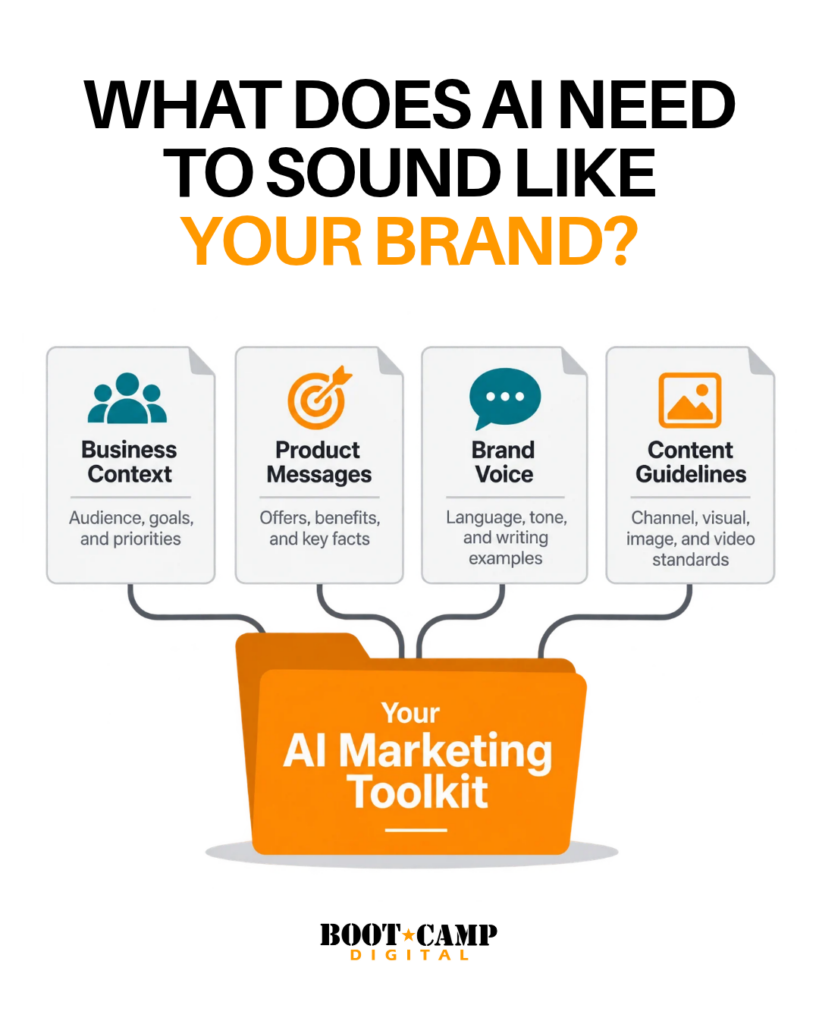
Business Overview
Create a document explaining your business, audience, goals, and priorities. Include context that AI cannot reliably learn from your website. This resource can support strategic planning and content development.
Product and Key-Message Fact Sheets
Document your products, audiences, selling points, and important details. These fact sheets help AI select accurate messages for each offer. They also reduce the risk of combining unrelated product information.
Brand Tone-of-Voice Guide
Explain how your brand communicates. Include word choices, formatting preferences, writing patterns, and clear examples. Add specific habits AI should avoid.
Channel-Specific Guides
Different channels require different approaches. Your general tone guide may prohibit emojis, while Instagram content may allow them. Channel guides capture those important differences.
Visual and Image Style Guides
Document your colors, fonts, logos, icons, and visual preferences. Include examples showing the desired look and feel. This helps AI create images that feel connected across channels.
Video Guidelines
Apply the same approach to video content. Define the visual style, structure, brand elements, and other repeated requirements.
Trust-Building Messages
Create a resource containing approved credibility points. This may include awards, client examples, ratings, or other verified proof. AI can then select relevant trust signals when content requires them.
How to Put Your Toolkit to Work
Start with a document that you can attach directly to prompts. This simplifies testing and keeps the asset portable across AI tools.
Once the document performs reliably, consider building it into another AI asset:
- Skills provide reusable instructions that users can call within different chats.
- Projects combine standing instructions, source documents, and multiple related chats.
- Agents support more complex processes, including automation and multiple skills.
Choose the option that fits your usage. Keep the original document as your portable source of truth. Test each new implementation again.
How to Test and Improve Your Toolkit
Testing should reflect how people will actually use the asset. One successful output does not prove the instructions work reliably.
Test a broad range of realistic scenarios:
- Long and short content
- Different audience groups
- Educational and promotional messages
- Detailed and vague user inputs
- Multiple AI tools
- Different starting materials, including images or basic ideas
When an output misses the mark, diagnose the issue before rewriting everything. Ask three questions:
- What is wrong?
- Why does it matter?
- What would a good result look like?
Then turn the answer into specific instructions. For example, an introduction might feel generic. Your revised guidance could require a concrete opening that immediately communicates the main point.
Show AI an acceptable output when written feedback remains unclear. Examples often communicate the standard faster.
How to Maintain Quality as You Scale
Scaling content also scales mistakes. Quality control must remain part of the process. A toolkit makes strong output easier, but it does not remove the need for review.
Create a scoring rubric with five to seven essential criteria. Focus on the standards that matter most. Ask AI to grade each criterion as yes, partial, or no.
Require evidence for every score. Then ask for the most important corrections. This produces more useful feedback than a general request to check the content.
Your rubric might evaluate:
- Brand tone
- Marketing objective
- Call-to-action placement
- Sentence length
- Required messages
- Verified claims
- Channel-specific formatting
You should also plan for variation. AI often produces content that is overly consistent. Request different approaches when you need multiple options.
Finally, keep a human reviewer involved. AI can compare an output with instructions and flag problems. It cannot replace your strategic judgment or understanding of the brand.
Start Building Reusable Context Now
Building an AI marketing toolkit requires time upfront. That investment reduces repeated prompting and revision later. It also helps other people produce work that follows the same standards.
Do not build everything at once. Choose one repeated task where consistency matters. A tone-of-voice guide or channel guide can provide a strong starting point.
Audit your current work, gather examples, and create the first resource. Test it in realistic situations. Improve the instructions until the output becomes dependable.
Then expand your toolkit based on actual needs. Each reusable asset gives AI better context. Better context creates faster, more consistent, and more on-brand content.
FAQs About AI Marketing Toolkits
What is an AI marketing toolkit?
An AI marketing toolkit is a collection of reusable business context and instructions. It helps AI create content that follows your brand, audience, goals, and standards.
Why do businesses need brand guidelines specifically designed for AI?
Traditional guidelines may rely on judgment or knowledge that employees already possess. AI needs more explicit context, examples, restrictions, and process instructions.
What should I create first for my AI marketing toolkit?
Start with a frequently used asset that affects many outputs. A brand tone-of-voice guide or business overview is often a useful starting point.
How many examples should I provide to AI?
Five to ten strong examples can teach AI more effectively than a general description. Choose examples that accurately represent your desired standard.
Should my AI toolkit live in a document, skill, project, or agent?
Begin with a portable document and test it thoroughly. Then move proven instructions into a skill, project, or agent when that improves access or scale.
How should I test an AI toolkit asset?
Test realistic content types, audiences, inputs, and AI tools. Compare each output with your instructions and revise any guidance that is ignored.
How often should I update my AI marketing toolkit?
Review important assets regularly and consider quarterly stress tests. Update them when AI behavior, business priorities, or content requirements change.
Can an AI toolkit replace human review?
No. AI can follow instructions, evaluate outputs, and identify gaps. A human must still judge strategy, accuracy, quality, and brand alignment.