
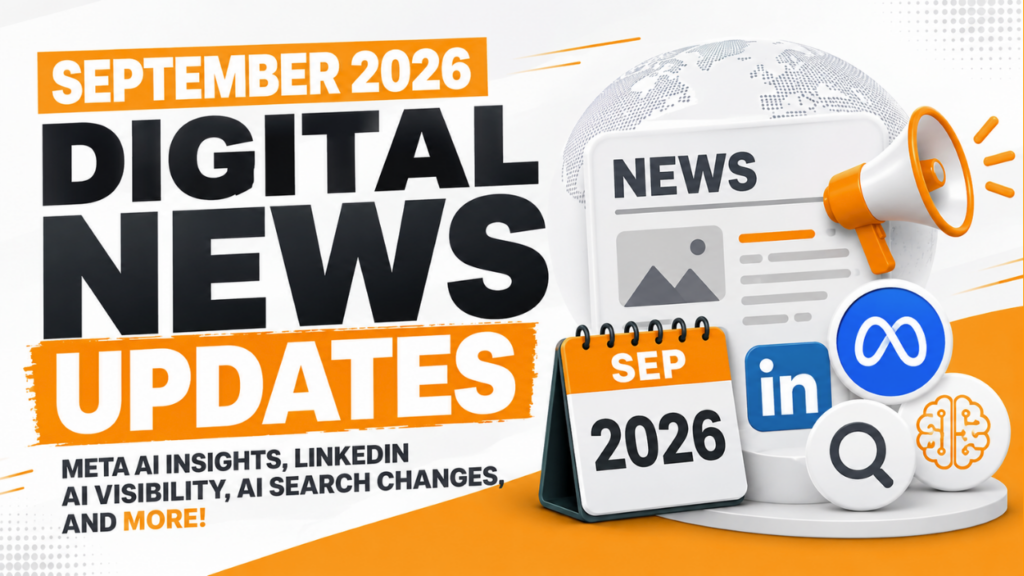
AI is becoming more integrated into the platforms you already use. At the same time, platforms are emphasizing automation, transparency, original content, and AI search visibility. These changes span Meta Ads, Instagram Reels, LinkedIn, Google Search, and AI answer engines. They can affect content creation, measurement, online presence, and how your business gets discovered.
With the All Access Pass, you get early access to our monthly Digital News Update sessions. We break down the changes that matter to marketers. You avoid spending hours tracking industry news yourself.
Meta News Updates
- Meta AI Can Now Analyze Your Business Data – Meta AI can now connect directly with several business data sources. These include Facebook and Instagram analytics, Meta Ads, and Google Workspace. You can use it to uncover campaign insights and identify potential improvements. You can also ask it to analyze organic content or advertising performance. It can even turn those findings into resources like executive presentations. This reduces the need to manually upload and analyze reports elsewhere.
- Meta Is Removing Some Ad Placement Controls – Meta is removing some manual placement controls from the ad set level. Instead, Meta will select placements based on your chosen campaign objective. A clicks campaign will prioritize placements expected to generate clicks. A conversions campaign will prioritize placements expected to generate conversions. Automatic placements have been a Meta best practice for years. However, some businesses use placement performance to make more nuanced decisions. Those marketers may need to adjust their strategies as these controls disappear.
- Meta Adds Exclusion-Only Custom Audiences – Meta now allows advertisers to create exclusion-only custom audiences. These audiences can include existing customers or people who opted out. They could also include people you deliberately do not want receiving ads. Existing customers are a common example for many acquisition campaigns. Excluding these groups can help prevent unnecessary advertising spend. It also gives marketers another way to improve audience targeting.
- Video Views Aren’t Measured the Same Across Platforms – What counts as a video view varies significantly across platforms. The definition can also differ between organic videos and paid advertising. Some advertising formats even let marketers define their desired viewing threshold. These differences matter when comparing performance between platforms. Understand each platform’s definition before making direct video performance comparisons.
Instagram News Updates
- Instagram Edits Adds More Tools for Creating and Organizing Videos – Meta continues adding features to its free Edits video creation app. You can now organize editing projects into folders. AI tools can also turn still images into moving clips. You can request movements like zooming or other visual changes. Edits also lets you save text styles for future projects. These additions make the app more useful for frequent vertical video creation. They can also simplify organizing, reusing, and remixing existing content.
- Instagram Shares Practical Video Editing Best Practices – Instagram shared several practical recommendations for creating stronger videos. Start with a hook that earns attention within the first few seconds. Match your visual pacing with audio when audio supports the video. Use text and visuals to reinforce the most important message. Finally, review your performance data instead of blindly following general best practices. Your own audience data shows which practices work best for you. These recommendations also apply across TikTok, LinkedIn, Reels, and YouTube Shorts.
- Instagram Refreshes Its Wordmark – Instagram has refreshed its wordmark after using the previous version for years. This is primarily a visual brand update. It does not require a major change to your marketing strategy. However, marketers should recognize Instagram’s updated branding when it appears across platform materials.
- Instagram Is Labeling AI-Generated Profiles – Instagram is adding more transparency around profiles featuring AI-generated people. These profiles can now display an AI-generated profile label. The update primarily applies to AI avatars and similar human-like identities. Instagram gives creators an option to apply the label themselves. Meta may apply it when an appropriate profile does not disclose AI usage. Businesses using AI-generated identities should be deliberate and transparent about that choice.
- Instagram Can Create a First Draft of Your Reel – Instagram introduced a First Draft feature for Reels. You can upload multiple pieces of footage into the tool. Instagram then selects clips and trims them into an initial video. You can edit and direct the draft after Instagram creates it. The feature does not replace your creative control. Instead, it gives you a faster starting point for video editing. This can be especially useful for turning event footage into quick content.
Snapchat News Updates
- Snapchat User Growth Remains Limited in Key Markets – Snapchat reported a slight active-user decline in the U.S. and European Union. Other parts of the world continued showing user growth. India represents one market contributing significantly to that broader growth. These trends matter when deciding how much to invest in Snapchat. Your audience location should guide whether Snapchat deserves additional marketing resources.
- Snapchat Research Looks at Humor in Marketing – Snapchat research examined how younger audiences respond to humor from brands. The research focused primarily on Gen Z and younger Millennial audiences. These users often appreciate brands willing to be humorous or self-deprecating. Humor can contribute to attention, consideration, sharing, and brand stickiness. However, entertaining advertising does not automatically sell your product. Humor still needs to reinforce your brand and marketing message. Marketers should also avoid adopting trends after audiences have already moved on.
LinkedIn News Updates
- LinkedIn Users Are Actively Flagging AI Slop – LinkedIn is giving users ways to identify generic, low-value AI content. More than one million people used the reporting option within roughly two weeks. That response shows people care about the quality of AI-generated content. Using AI itself is not necessarily the problem. Generic, thoughtless content without meaningful human input is the bigger issue. Your AI content still needs original ideas and a distinctive brand voice. Social platforms will likely become better at recognizing and deprioritizing low-value AI content.
- LinkedIn Can Turn Event Recordings Into Short-Form Highlights – LinkedIn can now recommend clips and chapters from recorded LinkedIn events. Recommended clips make longer recordings easier to repurpose into shorter content. Chapters also help viewers navigate directly to relevant sections. This can be especially useful for webinars and other longer events. Marketers can extend one recording across more content placements on LinkedIn.
- Individual LinkedIn Profiles Drive Most LinkedIn AI Citations – Research found individual profiles generate 75% of LinkedIn citations appearing in AI answers. Company pages account for the remaining 25% in the study. That does not mean company pages are unimportant. There are also significantly more individual profiles than company pages. However, individual publishing represents a major opportunity for B2B marketers. Status updates, articles, and newsletters can all contribute to your AI visibility.
- LinkedIn Shares How B2B Marketers Can Improve AI Search Visibility – LinkedIn created guidance for improving B2B visibility within AI search. Structure content clearly so AI systems can easily extract useful information. Include unique insights instead of repeating generic information already available elsewhere. Build credibility signals that support your expertise and authority. Coordinate content across teams to create consistent signals in multiple places. LinkedIn can become an important part of your broader AI visibility strategy.
Google and AI Search News Updates
- Google Search Console Adds Generative AI Performance Reporting – Google Search Console now includes generative AI performance reporting. Marketers can see generative AI impressions connected with their websites. Reports can also show contributing pages, countries, devices, and dates. This creates another way to understand how AI experiences surface your content. Similar reporting is also becoming available through other analytics platforms.
- SEO and AI Visibility Are Increasingly About Your Entire Online Presence – Modern SEO increasingly focuses on entities instead of individual websites alone. An entity represents the broader online information connected with your brand or business. AI systems can consider reviews, social profiles, videos, directories, and other sources. Product recommendations may include information pulled from third-party customer reviews. Those reviews might appear on Google, Facebook, Yelp, Trustpilot, or other platforms. Think about SEO and AI visibility more like online reputation management. Build credible information across your entire online presence, not only your website.
- Claude and Claude Code Find Answers Differently – Research suggests Claude and Claude Code gather online information differently. Claude Code frequently visits documentation, informational pages, and pricing pages. Claude more frequently accesses resources like robots files, sitemaps, and homepages. These differences demonstrate how AI answer engines can use very different signals. There is not one universal optimization formula for every AI platform. Focus on making credible decision-making information broadly available across your online presence.
- AI Citation Sources Vary Significantly by Industry – AI answer engines use different citation sources across different industries. Sources can include community content, brand websites, retailers, and independent editorial content. Consumer goods may rely heavily on brand-owned websites for specific product information. Other industries may receive far fewer citations from their own websites. These patterns can also change as AI systems evolve. Avoid building your entire AI visibility strategy around one current citation pattern. A broader information strategy can remain useful as individual engines continue changing.
- More Online Content Is Showing Signs of AI Authorship – Research found about 10% of webpages show significant signs of AI authorship. AI chatbot adoption still has substantial room to grow. About half of U.S. adults currently use AI chatbots. Only about 24% report using them daily. AI-created content itself is not automatically a problem. Problems emerge when businesses mass-produce generic content simply to manipulate search visibility. Search platforms continue prioritizing useful ideas, expertise, and relevant information. Marketers should use AI without replacing original thinking and genuine expertise.
- AI Mode Is Changing How People Search – Google research shows AI Mode is changing how people search. People increasingly search using voice and images alongside traditional text. They are also asking longer and more detailed questions. AI searches frequently support planning, finding, booking, and decision-making tasks. Brainstorming queries are also growing especially quickly. This behavior differs significantly from traditional short keyword searches. Marketers should optimize for user intent instead of focusing only on keywords. Provide the information people need to confidently make decisions.
- Social Media Is Becoming a Source for AI Search Answers – Research found social properties contribute to roughly one in 15 AI search answers. Facebook and other social content are appearing more often within AI results. This expands the role social media plays in search visibility. Your social content contributes to the broader reputation AI systems can evaluate. Social strategy and AI search strategy are becoming increasingly connected.
- Reddit Citations Are Dropping in AI and Search – Reddit citations dropped significantly within ChatGPT during August. Google AI experiences also showed declines in Reddit citations. The data clearly shows fewer direct links and citations going back to Reddit. However, citation declines do not prove AI systems stopped using Reddit information. An engine can use information without explicitly citing the original source. Marketers investing heavily in Reddit should still pay attention to this trend. Its role in AI and search visibility may be shifting.
AI News Updates
- Claude Is Adding Text Watermarking – Claude is introducing text watermarking for AI-generated writing. The watermark uses information embedded within text rather than visible labels. Readers will not necessarily see an obvious indication while reading the content. However, the watermark can make AI involvement traceable. Even light AI editing could potentially result in watermarked content. Businesses should consider how these transparency changes affect their AI content processes.
- Meta Is Flagging More Content as Made With AI – Meta is labeling more images and videos as containing AI-generated content. Many social media managers report seeing these labels on content created in Canva. Some labeled content only used AI-assisted editing tools, such as background removal. Other Canva graphics may also receive the label despite limited AI involvement. There is currently no evidence the label itself reduces content visibility. However, audiences may perceive labeled content differently depending on the creative. Avoid overreacting unless the label creates a measurable problem for your brand.